When you first start as a developer, the world feels simple.
The Product Owner gives you a task, a System Analyst explains the flow, or sometimes a Client tells you what they want. You take the requirements, write the code, test it, and deliver the feature. The feature works, the ticket is closed, and the sprint moves on. You feel productive.
That’s what a Junior Developer does well: turning ideas into working code.
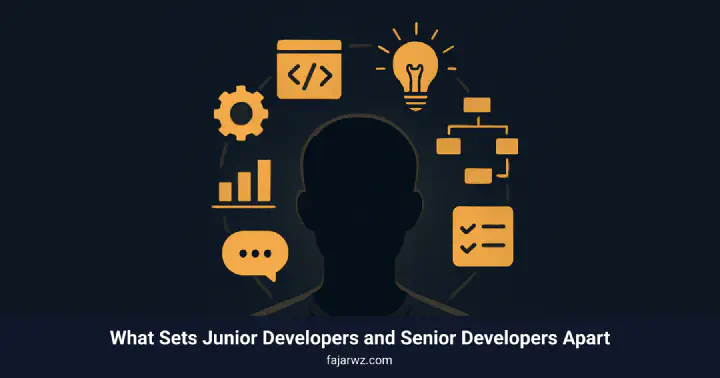
But there’s something that separates a Junior Developer from a Senior Developer. It’s not just years of experience, knowledge of frameworks, or knowing how to optimize a query. It’s the way they think.
The Task-Driven Mindset
Many of us start our careers thinking our main job is to do what we’re told.
We follow instructions, implement designs, and make sure the system behaves as expected. If someone says, “Add an icon next to that text,” we just code it, and done.
This mindset isn’t wrong, it’s the foundation of learning. Every developer goes through it. We need to understand syntax, architecture, and design patterns before we can challenge decisions.
But if we stay in this mode too long, something dangerous will happen. We might become people who have worked for 10 years with only one year of knowledge. We write code without questioning its purpose. We might produce features, but we don’t really solve problems.
The “Why” Behind Every Feature
Have you ever stopped for a second and asked,
“Why does the client want this?”
“What problem are we actually solving here?”
That “why” is what begins to separate junior and senior developers.
Software development isn’t just about building what people ask for. It’s about understanding what they really need. And those two things are not always the same.
Clients, product owners, or even analysts might say they want a specific feature because they believe it’s the solution to a problem. But often, they only see the symptom, not the cause.
For example, a client might request a button to export data because “users need reports.” But maybe what they actually need is a dashboard that shows insights directly, so they don’t have to export anything at all.
A senior developer spots this distinction.
A junior developer just writes the export button.
Clients Don’t Always Know What They Want
There’s a popular joke that says about how AI can’t replace software developers because clients must first know what they want.
“To replace programmers with AI, clients will need to accurately describe what they want. We’re safe.”

That’s funny, but also true.
Clients are human. They can misunderstand their own processes, change their minds mid-project, or make decisions based on assumptions. And that’s okay. Their expertise lies in the business domain, not in software systems.
This is why developers can’t just be executors of instructions.
We need to act as translators: turning unclear human intentions into clear, structured solutions.
If we don’t, we’ll end up in a frustrating loop:
- The client requests something vague.
- We build it as requested.
- They test it, realize it’s not what they meant.
- We rework it again and again.
The problem isn’t bad communication, but it’s the lack of collaborative analysis.
The Senior Developer’s Mindset
A Senior Developer doesn’t just focus on “what” to build, they start with “why”.
They ask questions like:
- “What’s the user’s pain point here?”
- “What’s the simplest way to achieve this outcome?”
- “Is there a better way to handle this in the system?”
- “Will this solution scale or cause problems later?”
They balance technical decisions with business value.
If a feature adds complexity without real benefit, they’ll speak up. If a request seems off, they’ll propose a better alternative. If something doesn’t make sense, they’ll clarify before coding.
A Senior Developer doesn’t see their job as “writing code.” They see it as delivering value through code.
It’s About Ownership, Not Just Execution
Ownership is another key trait that separates seniors from juniors.
A junior developer might think, “I’ve finished my part, so I’m done.”
A senior developer thinks, “Is this really solving the problem end-to-end?”
They take responsibility for the outcome, not just the output. They test, observe, and gather feedback. They want to see whether the feature truly improves the product, not just whether it runs without errors.
Growing Beyond the Code
You don’t become a senior developer the moment you hit five years of experience or master a new language. You become one when you start thinking critically about what you build.
When you:
- Ask “why” before you start coding.
- Care about how your code impacts users and the business.
- Communicate clearly with non-technical people.
- Think in systems, not isolated functions.
- Strive for simplicity over cleverness.
That’s when you start bridging the gap between writing code and building solutions.
Conclusion
The difference between a Junior and a Senior Developer isn’t about age, title, or how many technologies you know. It’s about perspective.
Juniors write code to complete tasks.
Seniors write code to create impact.
The journey from one to the other isn’t about moving up a ladder, it’s about seeing the bigger picture.
When you start asking why, thinking about users, and caring about value, you stop being just a coder, you become a problem solver.